 English
 Polski
 Română
 Italiano
 Español
 Português
 Magyar
 Lietuvių
 Ελληνικά
 Čeština
VAT and reverse charge on fabric orders: a buyer's guide
Which prices you see (with VAT for private customers, without VAT for trade accounts), when EU businesses buy at 0% under reverse charge, how VIES validation works and what happens with multi-warehouse orders.
·
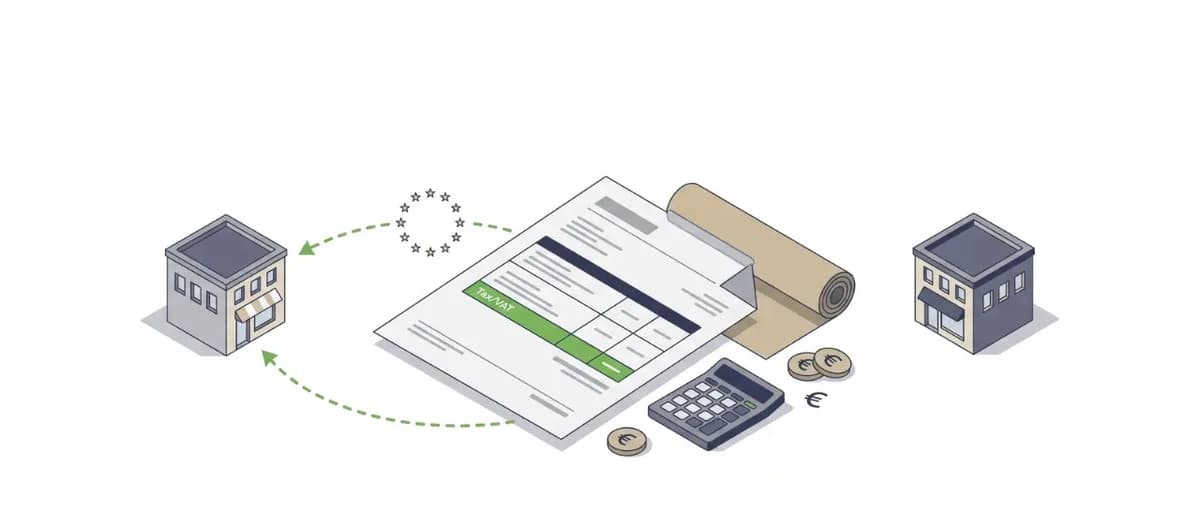
VAT on cross-border fabric orders confuses even experienced buyers: sometimes the invoice shows local VAT, sometimes 0% with a "reverse charge" note, and the same basket can be taxed differently depending on who is buying. Here is how VAT works at eshop.xmtextiles.com — the same rules our checkout applies automatically.
The short version
- Consumers and businesses without a VAT number pay VAT at the rate of the country our shipping warehouse's company invoices from — shown at checkout before payment.
- EU businesses with a valid VAT number from another member state buy with 0% VAT under the reverse-charge mechanism: you self-account for VAT at home at your local rate.
- Buyers outside the EU are invoiced at 0% VAT as an export, with export documentation; import duties and taxes are handled on your side.
Which prices you see: with or without VAT
Private customers and visitors who are not signed in see prices including VAT (23%, the Polish rate our e-shop invoices consumers at) — the amount you will actually pay. Approved trade accounts see net prices without VAT after signing in, because businesses reclaim VAT or buy at 0% under reverse charge. Every price is labelled “incl. VAT” or “ex. VAT” next to the figure, and the checkout always shows the exact VAT line by line before you commit — including 0% where reverse charge or export applies.
Reverse charge for EU businesses, step by step
- Choose «I'm buying as a business» in the checkout and enter your company's VAT number.
- We validate the number against VIES (the EU's VAT Information Exchange System) live, while you watch — and ask you to confirm the registered company details that come back.
- If the number is valid and the delivery crosses a border inside the EU, the order is invoiced at 0% VAT with the reverse-charge annotation required by the VAT Directive.
- You declare acquisition VAT in your own return at your national rate — for most VAT-registered businesses this is cash-neutral.
If VIES cannot confirm the number (the service occasionally lags national registries), checkout falls back to charging VAT; contact us and we will sort the invoice out.
One order, several VAT treatments
Because stock ships from warehouses in Poland, Romania and Portugal, a single order can legally be several supplies. Our checkout determines VAT per shipment: each delivery is invoiced by the company that ships it, under that route's correct treatment. You see this itemised in the checkout summary and on your invoices — the totals always add up to what you approved at checkout.
What you need for a clean B2B invoice
- An account with your company details — or a trade account for wholesale terms.
- Your EU VAT number, entered at checkout and confirmed against VIES.
- A delivery address in a different EU member state than the shipping warehouse's invoicing country (domestic deliveries carry domestic VAT — that's the law, not a shop rule).
This guide is general information, not tax advice — your accountant has the final word on your VAT position. The legal framework is Council Directive 2006/112/EC; the contractual terms are in our Terms & Conditions.